30 million for research into acceleration of climate change
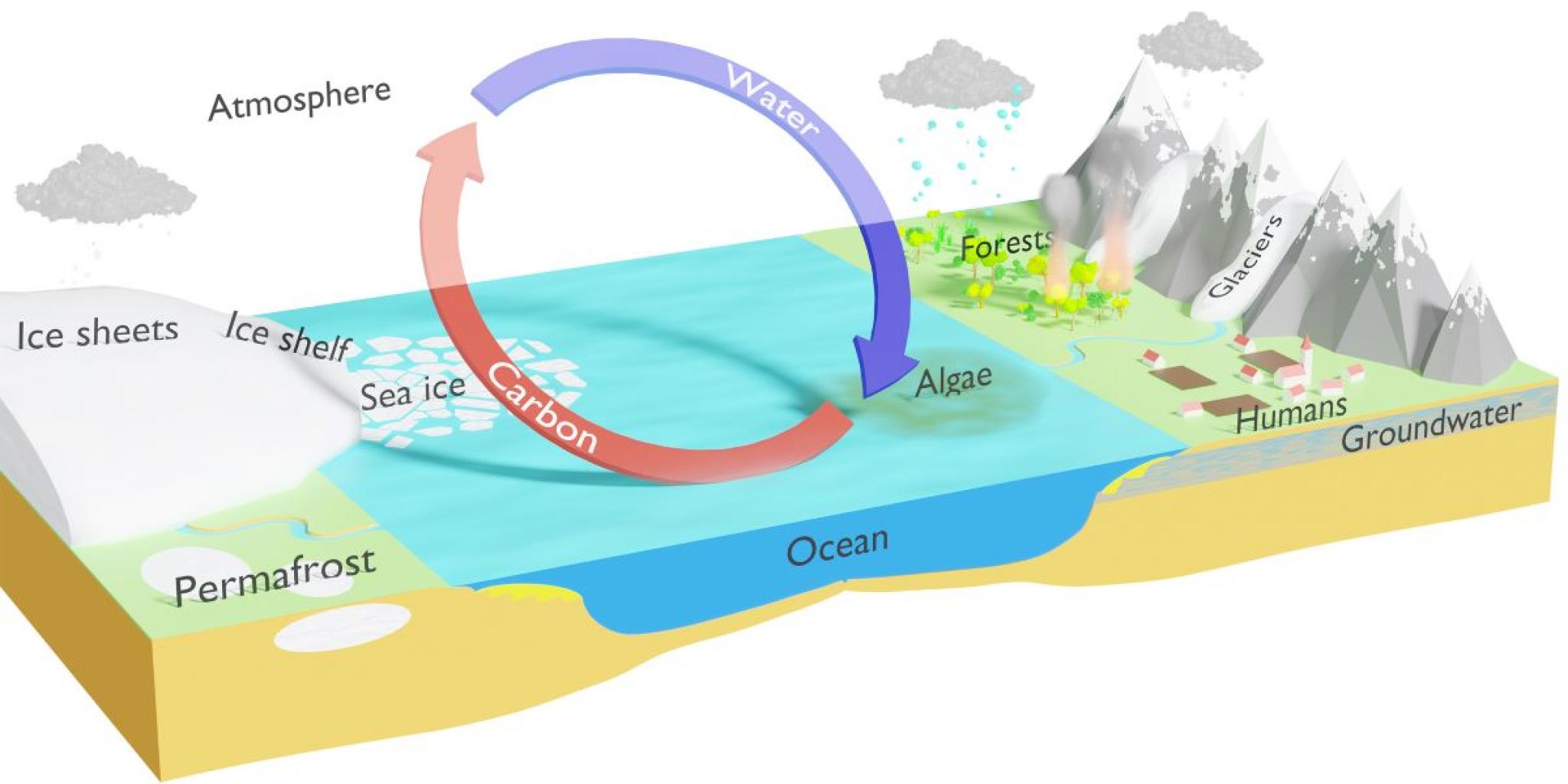
The EMBRACER project aims to connect all parts of the Earth system.
Climate change can be accelerated by feedback mechanisms: complex phenomena caused by climate change that in turn can further drive climate change. One example is the additional CO2 emissions from thawing permafrost. Research into the influence of long-term feedback mechanisms has been taking place for some time, research into modern climate change too, of course, but the link between the two has so far been understudied. EMBRACER, a globally unique centre with leading climate experts, is going to change this with a 10-year, €30 million research project funded by NWO. "This really is the next step in climate research.”

Group photo of the Embracer consortium. (photo: NIOZ)
EMBRACER stands for Earth systeM feedBack ReseArch CEntRe, a consortium of Utrecht University, the Royal Netherlands Institute for Sea Research (NIOZ), Vrije Universiteit Amsterdam, Radboud University Nijmegen and Wageningen University & Research. "In the short term, until the middle of this century, we have a good picture of how climate change is taking place," says Appy Sluijs, professor of Paleoceanography at Utrecht University. "But important feedback mechanisms work slowly and their full impact will only become visible in the coming decades to centuries. Even with rigorous climate action, they will determine Earth's climate well beyond 2100. So far, however, we lack the scientific understanding to anticipate their impact. So with EMBRACER, we are really taking the next step."
Bridging the gap
Within EMBRACER, 23 top Dutch researchers from a very wide range of climate sciences will collaborate: from earth scientists and geochemists to oceanographers, climatologists, polar researchers, hydrologists and ecologists. Thanks to this interdisciplinary approach and connecting research methods and time scales, EMBRACER bridges the gap between predicting short-term and long-term climate change. That such a thing is needed is shown by the fact that even the best future projections still take little account of feedback mechanisms, which are of great importance on time scales of decades to millennia. "But those future projections are the basis of climate policy," warns Sluijs. "Which means we may now be vastly underestimating sea level rise or warming in the second half of this century."
CO2 in the oceans
Gert-Jan Reichart, professor of marine geology affiliated with both NIOZ and Utrecht University, will focus within the project on the interaction between oceans and atmosphere, and how it will affect the uptake of CO2 in the ocean in the near future. "If we look in geological history, under normal conditions the ocean is the all-important factor for CO2. The atmosphere is a slave to the ocean, so to speak. But for the first time in millions of years, humans have reversed those roles: due to our emissions of CO2, the atmosphere now determines what happens in the ocean. This is undoubtedly going to have far-reaching consequences for the natural carbon cycle and thus for the evolution of atmospheric CO2 in the time to come."

The EMBRACER project aims to connect all parts of the Earth system.
Thawing permafrost
Earth scientist Jorien Vonk of VU University Amsterdam will focus on the feedback mechanisms of warming permafrost. This frozen ground contains about twice as much carbon as is currently in the atmosphere in the form of CO2. Enhanced thawing due to global climate warming causes this carbon to break down and produce CO2 or methane (CH4). "Our knowledge of the vast polar region is increasing, and fortunately the function of permafrost in the global balance of system Earth is increasingly named and recognised. However, CO2 emissions that occur as a result of thaw are extremely difficult to predict because local and regional variability is enormous," Vonk says. "I think that with the EMBRACER climate thaw team, together with the many international colleagues we work with, we can take an important step and better estimate how much this feedback will affect our emission reductions."
The future of tropical forests
Within EMBRACER, research at Wageningen University & Research (WUR) focuses on the fate of tropical forests. These are threatened by climate change and deforestation, even down to surrounding peatlands such as the Pantanal in the Amazon. Higher temperatures and longer droughts make trees vulnerable and drain the peatlands. "We thus run the risk that tropical forests will start emitting net CO2 and thus exacerbate climate change, whereas until now they did just the opposite," said Wouter Peters, professor of carbon cycle at WUR. An increase in the number of forest fires, WUR professor Guido van der Werf's field, may also play an important role in this. Together with other researchers within the consortium, they will measure CO2 fluxes in the atmosphere, forests and rivers to investigate the risk of many tropical forests disappearing, and to better understand what feedbacks on our climate this ultimately creates.
Increased methane emissions
Biogeochemist Prof Dr Caroline Slomp's (Radboud University Nijmegen) contribution to EMBRACER consists of research into emissions of the greenhouse gas methane (CH4). "Globally, the emission of methane from lakes and coastal waters to the atmosphere is increasing. Methane is a much stronger greenhouse gas than CO2 so this is a really big problem. We know that eutrophication plays a role: fertilisers from fields often leak into surface waters and cause a strong growth of all kinds of organisms there. When those organisms die and rot, you often get CH4. We want to investigate under what conditions that CH4 is formed and escapes to the atmosphere. Then we can also devise measures to reduce those emissions in the future."
Ice and ocean dynamics
Oceanographer Dr Anna von der Heydt of Utrecht University is investigating how the feedbacks play out for ice and ocean dynamics and their interactions with the carbon cycle. The polar ice sheets and the Gulf Stream are both cited as potential tipping elements, which could undergo abrupt transitions with global consequences. Although much is still unknown about these individual systems, their thresholds and dynamics, many of the feedbacks operate at the interface between these large-scale climate components. This means that ocean circulation and ice sheet dynamics are closely linked, including through their impact on the carbon cycle. Based on recent observations and past climate records, Von der Heydt and her colleagues aim to study and improve next-generation climate models for future long-term projections.
The geological past as a blueprint
Sluijs' contribution to EMBRACER consists of investigating climate changes in the geological past. "If feedback mechanisms are important in the future then they were also important in the past," he says. The reconstructions of climate change based on sediments once deposited on the seabed show that too. After the last ice age, permafrost melted in the Netherlands and 56 million years ago, a chain reaction of feedbacks caused a lot of CO2 and methane emissions. Our challenge now is to make the reconstructions so good that we find out why such feedback mechanisms became active, how strong they were and what influence they had on the climate. Combined with today's knowledge, that will provide predictive value for the future."
Linked staff
Gert-Jan Reichart
Head of Ocean Systems

Ellen Hopmans
Head of Analytical Laboratory
