RV Anna Weber-van Bosse
RV Anna Weber-van Bosse is the flagship of the renewed national research fleet, an 80-metre ocean-going research vessel delivered in early 2026. With state-of-the-art laboratories including wet, dry and geological facilities, plus space for up to 17 container laboratories on deck and in the hold and maximum of 31 scientific berth capacity, she extends Dutch marine research capabilities from coastal waters to the open ocean, from tropical seas to the edge of the ice in high latitudes.
The large aft deck supports heavy scientific equipment; A-frame and J-frame winches, cranes, and capability for deploying autonomous vehicles, ROVs, piston corers and multi-beam echosounders. Equipped with DP2 dynamic positioning and methanol-ready engines designed for a zero-emission future, she cruises at 10 knots and represents a generational leap in Dutch ocean research capacity.
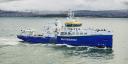
RV Anna Weber-van Bosse at the sea trials on 6 February at Vigo (photo: ARMON)
Specifications
- Length overall 80 m
- Beam 17 m
- Max. draught 5.50 m
- Max. number of berths: 47 (31 scientists + 16 crew)
- Service speed: 10 knots
- Dynamic positioning: DP2
- Special Purpose Research vessel, Ice Class IC (Finnish)
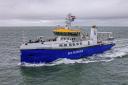
NIOZ research vessel Anna Weber-van Bosse first time at Texel (photo: Flying Focus)
Construction
In November 2022, the NWO-I Foundation Board approved the definitive grant of the contract for the construction of RV Anna Weber-van Bosse. After years of preparations she was built by Astilleros Armon Shipyards in Spain to a design by C-Job Naval Architects, replacing the RV Pelagia. The construction started in October 2023. She was delivered in early 2026 and christened by Queen Máxima on 12 March 2026 at Texel.

Christening of RV Anna Weber-van Bosse (photo: Evalien Weterings)
Name
Anna Weber-van Bosse was the first Dutch female biologist to contribute substantially to Dutch marine sciences, as evidenced by her many publications, huge plant collection and an honorary doctorate at Utrecht University, as the first woman in the Netherlands. The voyage aboard the Siboga led to Anna Weber-van Bosse's most important scientific contributions. She wrote about the contribution of calcareous algae to the construction of coral reefs in the East Indian archipelago, through publications on purple algae (Florideans) and a major reference work on red algae (Corallinaceae), among others.

Anna Weber-van Bosse (photo: collection Artis Library)