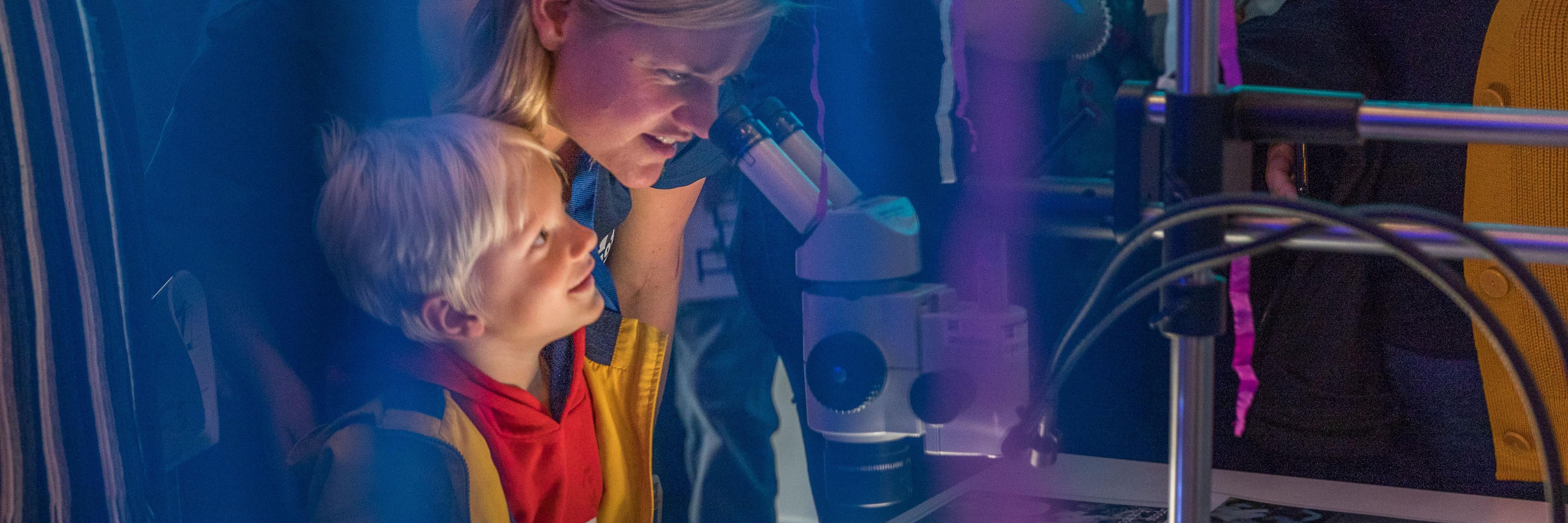
NIOZ Open Day Yerseke
On Saturday 10 October, NIOZ Yerseke will open its doors to the public for an Open Day. With activities, experiments and talks, our staff will give you a look behind the scenes of marine research.
Sea, Science, Society
Are you curious to the very bottom? Dive into the depths at our Open Day! Observe marine life through a microscope or in the aquariums, and get hands-on with plankton, seaweed and oysters. Look through VR goggles, build a sea wall out of Lego and learn more about coastal protection and rising sea levels. There’ll also be talks, an exhibition marking 150 years of NIOZ, and demonstrations of our research equipment. This is how we’ll show you how water, science and our world are all connected.
Below are a few examples of the many things on offer that day. We’ll be updating the programme over the coming weeks, so keep an eye on this webpage.
Practical information
- Date: 10 October 2026
- Time: 10:00 until 16:00
- Adress: Korringaweg 7, Yerseke
- Entrance free, no registration needed
- Suitable for visitors of all ages
The puzzle of the food web
An alga is eaten by a fish, which in turn is eaten by a bird. That seems like a simple chain of predation. But in reality, the food web is much more complex. Can you piece together the puzzle of the food web in the Wadden Sea?

(photo: Risto Raunio/Shuttershock)
Dike breaches
To protect ourselves from rising water levels, we have to keep building our dykes higher and higher. Or is there another way? Build a dyke out of Lego and discover how plants can help make our dykes stronger and better protect us against rising sea levels.
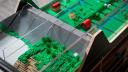
First aid at dyke breaches with the LEGO kart (Photo: NIOZ)
Invisible life in the water
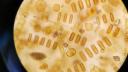
A drop of seawater may look clear, but it’s actually teeming with life! Discover this in our plankton lab, where you can use a microscope to examine various ‘water droplets’ and learn all about these tiny plants and animals.
A bit more about seaweed
Is seaweed the food of the future? Come and see what different types of seaweed live in the local area. You can make your own seaweed art, learn more about what you can use seaweed for (not just for eating!) and why it’s a good idea to do so.
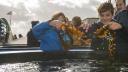
Seaweeds in Yerseke (Photo: NIOZ)
Lecture programme in the Oosterscheldezaal
Protecting nature and our health through nature
Speaker: Jeroen van de Water, marine ecologist
At 10.30 and 13.00
Sea-level rise along the Dutch coast
Speaker: Theo Gerkema, physical oceanographer
At 11.00 and 14.00
Oysters as natural coastal protectors
Speaker: Brenda Walles, marine ecologist
At 12:00 and 15:30
Adapting to rising sea levels: towards new, natural Delta Works
Speaker: Jim van Belzen, coastal ecologist
At 11.30 and 14.30